Friday, January 21, 2011

After a little background reading about OPEC, I really saw the Big Oil cartels in a new way.  First, it is clear that they are purposefully drilling at below capacity and or selling at so that they can keep a shortage and hike up prices more than the competitive market would allow if there were a higher supply.  (Before this week's lesson, I have to honestly say I did not fully understand why OPEC was doing this.)  Since the market is mostly inelastic in the short-run, the demands remain the same and countries essentially must pay the price to have oil (I see there are other posts about elasticity so I'll leave that alone for this post).  OPEC countries realized the inelasticity of the market after they placed an embargo on the US for the US defense of Israel in a Middle-East conflict.  Realizing the power they had over market prices, those Arab countries formed a cartel in the early 1980s that literally dominated the market, and used shortages to essentially charge whatever price they wanted.  

However, the market since then has become more competitive as more suppliers entered the market, moving the supply curve to the right and thus driving down prices (although supply is still short of demand).  With OPEC in check a little, the market is now more competitive, which is good.  Which is why, on a strictly economic basis, drilling for oil in Alaska would make sense as far as lowering prices for oil.  Even at the current prices which are relatively low, however, world supplies are kept short.  The market proving to be elastic as countries like India continue to develop mean that oil-producing countries must still step up production if they want to keep a share of the market.  OPEC says they're drilling at much higher capacity now than ever before.  Although keeping the supply low would still help prices, they would lose their market share.  More increases in the supply curve are now being balanced by increases in the demand curve, so prices overall are pretty stable and relatively more fair than when OPEC was completely in charge.  However, no oil producer wants to cut themselves out of the profits that can be made through the short supply, so they have to constantly be looking at demand and then falling short of that.

A little story about price gauging I read in Mankiw's textbook Principles of Applied Economics on how price gauging has its benefits got me thinking: Maybe this Big Oil/ OPEC strategy is not actually that bad.  It means that there will be enough oil for those that really need it and keeps demand in check for this valuable non-renewable resource.

Saturday, September 12, 2009

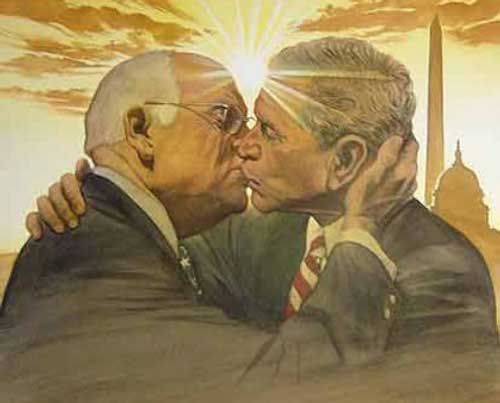
Take a Clue From W

We're all thinking this & I have to shout in this blog:

GROW SOME CAJONES OBAMA!!!!

Wednesday, August 26, 2009

Public Option Cartoon


Hilarious Political Photo of the Day


Repost From DailyKos.com


UPS drops ALL Fox advertising, Not Just Glenn Beck!! Updated with email to UPS


Digg this!


Share this on Twitter - UPS drops ALL Fox advertising, Not Just Glenn Beck!! Updated with email to UPSTweet this

submit to reddit

Share This

Mon Aug 24, 2009 at 09:52:38 AM PDT


Rich Hallabran, spokesman for UPS Stores, said
today he has not only temporarily halted buying ads on the Glenn Beck
Show but also on the Fox News Channel altogether as reported by AP Television writer David  Bauder


Congratulations to Color of Change
for a boycott that has successfully driven 33 companies away from the
odious and racist rantings of Glenn Beck!  Beck is returning from
vacation to even fewer advertisers than when he left!


UPDATE: You can send UPS a thank you email at customer.service@ups.com

And while you're at it, please urge them to make this temporary move a permanent one!


This is personal for me.  As a business owner I
receive several shipments a week from UPS, and I've been badgering them
relentlessly by email, giving them a deadline of September 1st before I
move to FedEx and make  my vendors move with me.  It wasn't a hollow
threat, either, inconvenient as such a move would have been.  I've
never been part of a successful boycott before!


And now, not only UPS but a total of 33 companies have joined the boycott, including Clorox, CVS, and Sprint.


While the UPS move is "temporary," UPS is still the first company to
remove their advertising from Fox News altogether, instead of just
directing that ads be placed in other advertising slots.  


I've never watched Glenn Beck myself (shudder) but I understand that the UPS logo is shown introducing his show.  


The fallout from advertisers may well spill over into other controversial cable news shows.


The shows present a dilemma for advertisers, who usually like a
"safe" environment for their messages. The Olbermanns, Hannitys,
O'Reillys, Maddows and Becks of the TV world are more likely to say
something that will anger a viewer, who might take it out on sponsors.


They also host the most-watched programs on their networks."This is a good illustration of that conundrum," said Rich Hallabran, spokesman for UPS Stores.


Wednesday, May 20, 2009

Extremely Disturbing

I've always thought of "fighting hate" as somewhat of a misguided approach. Hate can only come about through understanding. Clearly, some have missed this idea.

During a time of economic crisis, a failed war on terrorism, and widespread environmental destruction and catastrophe, people in the US seem to be dealing with this in two main ways: Trying to work together for the greater good despite personal issues or losses; or blaming the world's problems on the "other" and perpetuating the hate.

Here is a deeply disturbing example of this.

When I see things like this, I see fear, hate, and powerlessness. I can only ask in awe, How can we overcome this to build a better society?

Monday, April 13, 2009

Gay Marriage vs Civil Unions: An Equal-Rights Predicament

PART I: Are Civil Unions Really Different?

As Vermont becomes the 4th state to recognize same-sex marriage, many civil rights activists across the country (& indeed across the world) are sounding their rejoice. But the law granting same sex-marriage has some otherwise equal-rights supporters reeling, and the reason is Civil Unions. Whatever became of them? Civil Unions were originally seen as a sort of concession to the idea that marriage can still be a sacred institution of God but if you wanted to you could still have legal rights. The argument is multi-faceted, but today, we focus on simply what the legal differences are between marriage & civil union.

First there is the connotation that they are different institutions & that strait ppl are barred from civil unions. Marriages carry centuries of connotation that seems to be undesired, esp by many young liberals (such as in Vermont) who have seen marriage be corrupted by affairs, domestic violence, divorces after 2 weeks, ugly custody battles, & general long-term misery. A common phrase heard: "I want a civil union with another strait person!"
In fact, civil unions have been on the books in Vermont since 1990, a fact largely unnoticed nationally.Read the full language of the Vermont Civil Union law.
§ 1202. REQUISITES OF A VALID CIVIL UNION

For a civil union to be established in Vermont, it shall be necessary that the parties to a civil union satisfy all of the following criteria:

(1) Not be a party to another civil union or a marriage.

(2) Be of the same sex and therefore excluded from the marriage laws of this state.

(3) Meet the criteria and obligations set forth in 18 V.S.A. chapter 106.


The law expressly gives civil unions to homosexual couples- in other words, if you are heterosexual & want benefits, you must, like it or not, get married. Apparently the more egalitarian-sounding Civil Union is just as inaccessible for strait ppl as the sacred-sounding marriage still is for most gays, proving that the exclusion of individuals from such institutions cuts both ways. Therefore, whether the rights are or are not the same, these sorts of laws are like the White Drinking Fountain vs Black Drinking Fountain: A step up, but clearly not the answer.

Although not entirely fair purely by definition, it is important to know why Civil Unions are seen as an important legal definition. An extensive thrashing through constitutional documents & hearings transcripts at The Senate Website shows that as of today, there is no federal or constitutional definition of marriage, nor has the Supreme Court made any ruling on the matter. The states themselves are left to define what marriage means, &, importantly, what rights married persons receive. All states but five have constitutional amendments that define marriage, though only three states specifically prohibit gay marriage. Civil unions are, however, still allowed by these definitions (as Vermont itself is also one of the states that contained such a definition). Technically, every state can enact civil unions for homosexual OR heterosexual couples by legally granting access to the set of specific rights for those who obtain a license. Most importantly, this can be done without constitutional amendment.

Such an idea begs the question: Are separate-but-equal rights the same as equal rights? Just WHAT is in the law for a marriage (besides that it is between a man and a woman) that a civil union doesn't have?